 Click HERE to return to the contents page
Click HERE to return to the contents page
CASE STUDY AND ANALYSIS FOR A SUSTAINABLE QUALITY - MANAGEMENT IN A UNIVERSITY LIBRARY

 Translation from English to Swahili
Original Link

Cristina Albu, Narcisa Valter, Adriana Cristian and Mioara Duca
University “Politehnica” of Bucharest, Romania
Putting a service into place in such a way as to avoid any major difference between expected quality and perceived quality requires an analysis aimed at identifying the means for improving its quality. In this respect, the paper presents such an analysis based on service provision processes and methods involving SERVQUAL type questionnaires filled in by library users. In our case study we have mapped out the current state of service quality perception in a university library. Furthermore, we have made a comparison with the results obtained in similar studies on info documentary structures running in different operating conditions. We have also listed recommendations for ensuring sustainable success in university libraries that are operating now in a rapidly changing environment.
Keywords: quality management, university library, evaluation, SERVQUAL
questionnaire.
JEL Classification: I25, L31, M14, O32
The steady concern over obtaining continuous improvement is likely to yield expected results. At the same time, quality, in its threefold status (planning, control, improvement), enables the organization to achieve its objectives.
The provision of services in the university library is an activity focused on
satisfying the
demands of internal and external users. Among the criteria that fundamentally
distinguish
service provision from goods manufacturing activities we might include:
- intangibility: services through their very nature are intangible;
- inseparability: the overlapping of services production and consumption in
time;
- un-stockability: services cannot be stored for later use;
- variability: the service cannot be repeated identically;
- user-librarian (provider) interaction: the user is physically (online)
present.
...
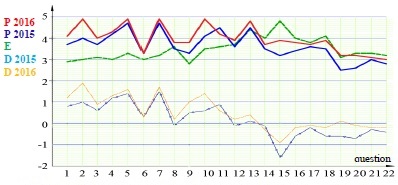
Figure no.1: Graph representation of average perception/average expectation
Source: Authors
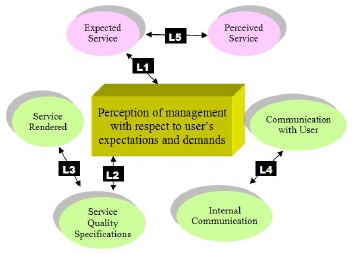
Figure no. 2: Drawing a critical path factors (L1 ... L5) causing gaps in the
work of a
university library
Source: Authors
An important role pertains to staff training as well as their behavior. The user often evaluates service quality based on the librarian’s ability to grasp the user’s preferred type of interaction.
The selection and training of customer first team who are in direct contact with
users has
great significance. The users’ feedback and complaints may be taken as a
starting point if
the library plans to improve its services. It is never possible to make all
users happy, no
matter how high the service quality is. Yet, there must be some tolerance zone
for
acceptable service. From the analysis of questionnaires, some of the users’
complaints seem
to suggest the need for:
- improved internet connection (more efficient location of Internet outlets);
- longer lasting/more durable reader permits;
- more internet cables;
- switch to Wi-Fi connection;
- internet supply in individual cabins;
- more efficient air-conditioning in reading rooms during summer;
- more lecture halls opened during the exam session;
- more kindness from the staff;
- shorter time for processing doctoral theses.
The SERVQUAL Questionnaires represent a model for improving service quality from the user’s point of view, starting from the discrepancy between the perception and expectations regarding the service to be rendered. The measurement of this discrepancy takes into consideration five dimensions: reliability, assurance, tangibles, empathy, solicitude.
The analysis of users' satisfaction is the basis for finding procedures of continuously improving service quality. One approach needed to ensure continuous improvement of user satisfaction is the use of the "Conceptual Model of Quality Service”.
The degree of user satisfaction can be measured by different methods. Example: SERVQUAL questionnaires.
The Quality Management system should take into account the issue of human
resources
commitment in:
- creating an appropriate environment;
- considering human relations as an essential part of service quality
(user-person in
direct contact with the user);
- recognizing the importance to be given to the user’s perception of the image,
culture and achievements of the library;
- developing the qualification and capability of library employees;
- motivating employees.